Saturday, December 26, 2015

The BMW i3 and Solar PV, an enriching relationship at a beautiful scale.

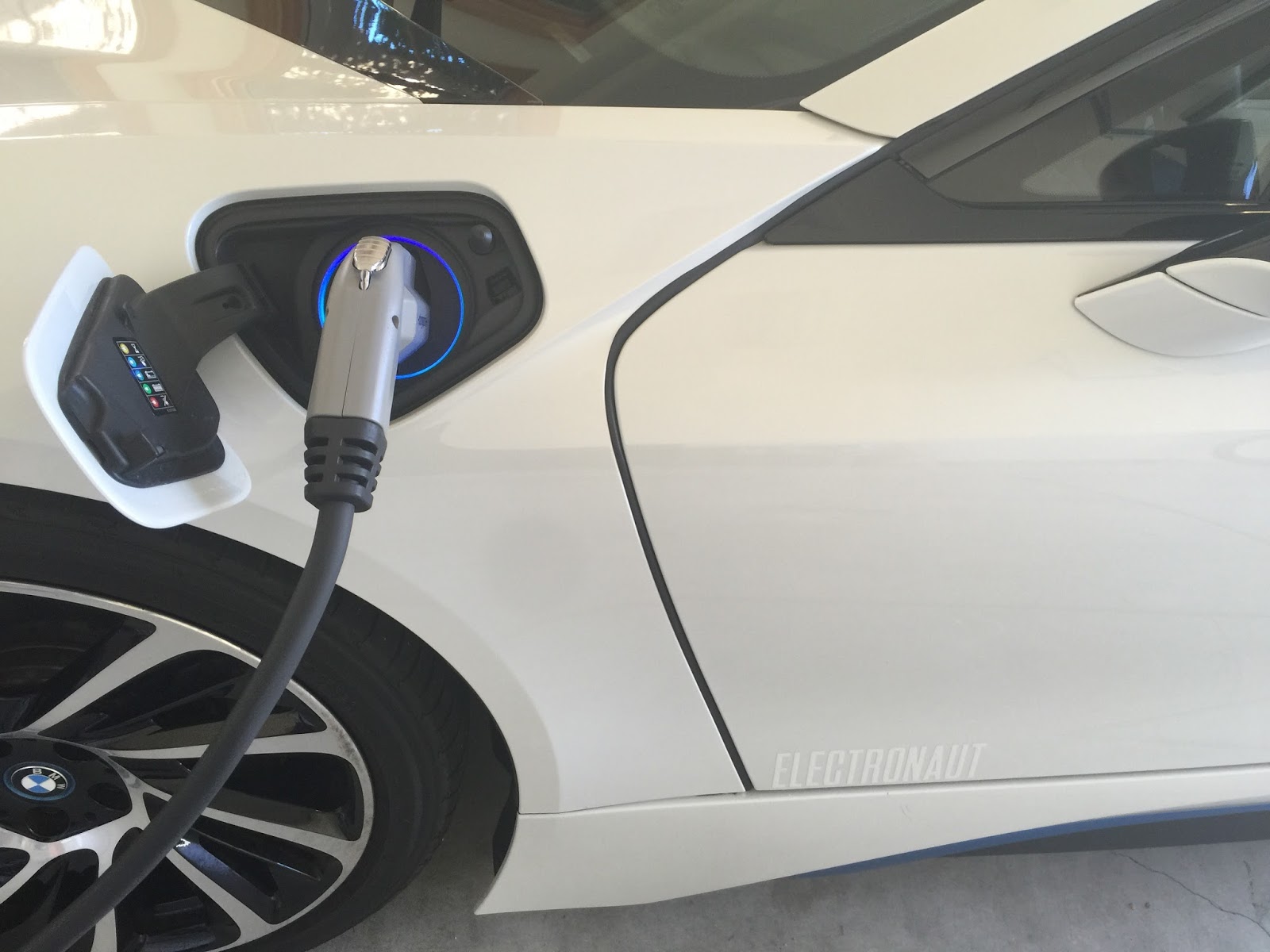
It's just 30 ft.  from the panels to the EV plug. 

We've arrived at zero net cost (-$472 actual) for the energy required to live in our home and drive our two electric BMW i3’s powered by Solar PV.

The utility savings from our Solar PV system installed in 2007 and the gasoline savings from our EV driving beginning in 2009 with the BMW Mini-E, led to our energy plant / Solar PV system being fully paid off in April of 2012.  For our family, we have an ongoing savings of around $8000 a year continuing for the next few decades. 

But there’s another side of the story to tell, a story of design scale and the relationship between the car and the source of fuel that's both surprising and fascinating.

Design. 

Good design has a natural scale, for example the scale of an object as compared to a person, such as the height of a ceiling.  Or the proximity of an object to another object or person, such as landscaping, that when done well provides a sense of comfortableness, a feeling of beauty.  It works well and fits together nicely.  

When not done well, a poor design scale can seem awkward, weird, and uninviting.  “What the heck were they trying do here” is a typical response resulting from poor design scale.  

Now let’s take a look at the design scale between the car, a parking space, and the space required to power the car a typical 12,000 miles a year.

An average parking space for a car is 9 ft. by 18 ft. for a total of 162 ft. An average residential garage space per car is even greater at more than 200 sq. ft.


From our real world "Driving to Net Zero" experience, we know that our car the BMW i3, requires 2860 kWh to drive 12,000 miles.  We also know that for each kw in system size our Solar PV system located in coastal California produced 1588 kWh.   For our individual situation, a Solar PV system size of 1.8 kw is required to provide the electricity to drive our BMW i3 12,000 miles a year.

For a better comparison, let’s design an average system size that will work for the majority of electric cars in all areas of the USA.   

The efficiency of electric cars range from 3 miles per kWh to 4.2 miles per kWh. Additionally, solar resources vary across the nation.   Factoring in the lowest solar resources and a larger EV,  a 3 kw Solar PV system size  is needed to power the vast majority of eclectic car choices 12,000 miles a year, anywhere in the USA.
Solar resources across the USA.

How large is a 3 kw Solar PV system?   The SunPower X21 panel produces 345 watts and is 17.57 sq. feet in size at 61.4inches by 41.2 inches.  8.7 panels are needed for a 3 kw system size but let's call it 9 panels for 3.1 kw system to keep the math easy for a total of 158 sq. ft.

To recap:

A typical parking space for most cars anywhere in the USA is 162 sq. ft.

A Solar PV system in California, 12,000 miles in a BMW i3 is 92 sq. ft.

A Solar PV system anywhere USA, 12,000 miles in any EV is 158 sq. ft.

That’s a beautiful proportional design scale.  The size of the space required to park a car is larger than the space it takes to provide power for the car.

You're probably thinking to yourself, this will never work, the $9,000 to install the 3 kw Solar PV system for the car over one parking space is too expensive.

Do you ever think about how expensive that parking space is?  A paved parking space can run from from $4,000 to $40,000  (source link)  each depending on location and we've managed to build 4-5 for each car in our cities.  One space at home, one on the curb, one at work, and one or two out in the city for your use as you shop and run errands.

When you add up the multiple parking spaces per car, it's very clear that providing parking for the car is many times more expensive and land intensive, than providing the energy to power the car during a 25-40 year time frame.  It cracks me up that we still refer to it as free parking.

The parking spaces can be more expensive than the Solar PV.
  
Relationship.

A relationship can be a coupling, cause and effect, harmony between two or more,  the way two or more are connected, a symbiotic reliance on the other.

All cars need an energy relationship to move.

Currently most cars have a required relationship with a gas station. You simply must fuel your car at a gas station.   The gas station stores and dispenses the fuel that arrives by tanker truck from the refinery.  The refinery receives the crude oil from a tanker or oil pipeline.  The oil tanker receives the crude oil from a pipeline or tanker truck that receives it from an oil well or oil source.  

This conveyance chain of hydrocarbons to your car can be thousands of miles long traversing oceans. In this long carbon chain, you are the payer at the end of the chain with all the owners of the pieces of the chain enriched by your payment. 

This long hydrocarbon conveyance chain is also very inefficient, resulting in less than 20% of the original energy contained in the crude oil reaching the wheels of your car where they meet the pavement.   

The electric car also has a required relationship with electricity.  This can be made from many more sources including Solar PV that sits on the roof or carport above one of the parking spaces provided for the car.  The conveyance chain can be as short as 30 feet, from where the sun shines on the Solar panel to your car.  

This electricity harvested from the sunshine supply chain to your car is owned entirely by you.  This conveyance chain supplies the electricity to your car where your car is parked and results in over 85% of the original sourced electricity reaching the wheels of your car where they meet the pavement.

That’s a beautiful relationship between the car, electricity and nature that ultimately enriches you the owner.   We can provide the electricity for our cars in this space with Solar PV at a fixed cost equivalent of $0.50 - $0.75 per gallon of gasoline.

Relationships and design...They matter.


Our BMW Mini-E and our fuel station in 2009.


Friday, December 18, 2015

The Highest EPA Rated Mass Produced Vehicle Off All Time! 500% More Efficient Than The Average New Gasoline Vehicle.


You can live and drive powered by sunshine.

Julie and I are fortunate enough to both own and drive BMW i3 Bev's powered by sunshine. Our BMW i3's are the principal reason along with Solar PV and a very efficient home, that we are able to live and drive with zero net utility or gasoline cost.

The BMW i3 is rated by the EPA at 177.7 combined mpg rating (using unadjusted laboratory figures) according the article, an unbelievable 5 times more efficient than the the average new gasoline vehicle which is rated using the same methodology at 31mpg unadjusted.  (Source NPR)

That directly translates into more wealth for those owners and families who own the car, (or any other electric car) and cleaner air for us all.

Consider this from a San Diego perspective.

If we as San Diegans achieve 50% electrification of our transportation fleet, we would reduce by 30% the overall emissions in San Diego County. 59% is the total emissions created by our transportation choices. Just as importantly, we would also be creating wealth and economic savings for our families and communities by reducing the cost of transportation fuel.


Our sources of emissions in the City and County of San Diego


A shift from oil to electricity in our transportation choices enables efficiency gains of up to 700% thus creating economic wealth. As just one example of this, the EPA rates the average new gasoline vehicle at 31mpg unadjusted and the new BMW i3 at 177.7 combined mpg rating (using unadjusted laboratory figures). This is a greater than 500% improvement in miles traveled using the same amount of energy.  The cost savings,wealth generation and improvement in air quality implications if our experience were replicated in an entire city, state or nation is staggering and incalculable.

Most understand the energy savings of a LED bulb versus an incandescent bulb; the same amount of light for 1/5th of the energy used, electric transportation is similar.   In any energy or emissions strategy, efficiency is always the highest priority in the loading order and is wealth generating at an equal percentage to the savings. 

Using our real world experience gained in the "Driving to Net Zero"
Challenge, as compared to the best utility rate and gasoline.


Our highest priority should be reducing and ultimately eliminating the 59% of our emissions in the County of San Diego that are caused by our transportation choices. We can do this by electrifying our transportation choices coupled with equal effort; land use planning that reduces vehicle miles travelled offering greater mobility choices.

As Americans, a long-standing national goal shared by several Presidents of both political parties, has been to reduce and ultimately eliminate our dependency on foreign oil. In 2014, nine millions barrels of oil daily were imported from 75 countries representing 46% of our total oil consumption. We are currently fighting wars involving cost in both money and blood, because oil is still regrettably a strategic concern.

Focusing on getting to 100% renewables in our San Diego electricity grid does zero to contribute in solving this national problem, as our grid contains zero electricity produced with oil.

Focusing on transitioning to electric transportation choices ultimately solves this national problem as the majority of our oil is used and refined to make gasoline.

Looking regionally, are we really willing to dot our backcountry and uproot farmland with hundreds of 50 to 1000+ acre Solar PV power-plants in order to accomplish the goal of getting to 100% renewable energy? (For the record I have supported with concerns, the first several installations as a San Diego County Planning Commissioner.)

Or is the better strategy at least for the next few decades, something less than a 100% renewable energy electricity grid, with a preponderance of distributed renewable energy installations owned by hundreds of thousands of energy entrepreneurs on our existing buildings, parking lots and garages/carports? Solar PV installations that are focused on reducing the four times greater transportation emissions as well as our building emissions.

There are currently 72,000 energy entrepreneurs with solar PV systems in the SDG&E service area. This number is 50x more than existed 10 years ago. In the next 10 years we can easily predict 10x this number.  The energy grid is evolving into a more equitable grid whereby if you provide a benefit, you'll make money, if you are a net user you'll pay money.  Soon there will be millions of energy entrepreneurs on the energy grid.  Sounds like what happened to our communications grid doesn't it?

We have a lot to think about and plan for, unprecedented changes are happening in our transportation and energy sectors. It’s an exciting time of opportunity on all fronts.

Electricity including renewable energy should be thought of  first and foremost as a transportation fuel. 

That’s both our greatest challenge and our greatest hope. Let’s get to work.

Thank you BMW for making a fantastic car to drive, for enriching our pocket books and for helping clean our air.


Wednesday, November 18, 2015

The BMW i3 Gives You A Choice


You can choose to not contribute your money to wars and terrorism funded by proceeds from oil.

It just takes a little sunshine...

Thursday, October 22, 2015


I am a fan of Tesla but I can't believe the risk they are taking with the autopilot.
They are one crash involving a fatality away from seriously damaging their company.

This is an area where caution is needed, not brash bravado.

Just my opinion.

Friday, October 16, 2015

The Driving to Net Zero Short Film.

Through dozens of articles and thousands of words, we have told our story of living and driving powered by sunshine.   We've encapsulated this year long story into a brief 90 second short (very short) film. 

To all parties including media interested in sharing this story, please feel free to reproduce, link to or use free of charge the video and any of the writings during the Driving to Net Zero Energy Challenge. 

================================

After 100 years of little change,  revolutionary changes are now underway in our transportation and energy segments. 

The "Thermal Age" is ending.
The "Renewable Age" is beginning.

The transition will take some time... however:

Never before has it been possible for a homeowner to create their own energy for their home and cars.

Never before has it been possible to power a home and cars with carbon free, emission free, energy that is less expensive than fossil fuel sources.

Never before has it been possible to so broadly share the wealth of energy among both individuals and corporations with equity to all reaches of our planet.

I am very optimistic for a wonderful future,  and I believe a new definition for living a healthy and premium life is required.   It simply must include a strong partnership with nature, using the renewable energy provided by nature.

renew your faith,
renew your optimism,

Cheers!


Wednesday, September 16, 2015

100+ MPG In Our BMW i8

As a long time EV only family, I had to “squint and surrender” my EV only purity ethic a little bit when I indulged my passion for the breathtaking aesthetics, technology and performance of the BMW i8.  A truly once in a lifetime car.

Yes it's possible to get 100 MPG driving in the BMW i8, easy in fact for mostly local drives, but you have got to plug in.  

A month of typical driving in the BMW i8,  The MPG pegs at 99.9
If I were to guess the true MPG,  It would be around 150mpg.

This past month driving around our semi-urban, suburban home turf of Carlsbad California, our BMW i8 returned a fuel efficiency of somewhere north of 100 mpg.   I expect this will be the normal life of our i8 in the years to come with the exception of a long road trip or two annually around America in which we average around 30mpg. 

It’s an amazing world when a rocket ship from the future like the BMW i8, can return 2x, 3x, 4x, 5x the mpg of its competitive class. Trust me, almost every drive in my i8 involves a moment of two in sport mode. Sometimes as short as 3.6 seconds.  

Urban, Semi-Urban and Suburban towns and cities are where PHEV's
are a very good choice.  Driving Hwy 101 in Carlsbad Ca.

But that’s not why this drivetrain is so newsworthy.

It’s newsworthy Because BMW is populating it’s entire lineup with derivatives of this BMW i8 drivetrain.  This year, the BMW  3, 5 & 7 series along with the X5 will all be available as Plug In Hybrids using similar  drivetrains as the flagship BMW i8. In the coming years, every series and type of car produced by BMW will have a PHEV option.

Will these PHEV's work well? Will they sell well? Will they offer a substantive improvement?

Bank on it.

My experience as a BMW i8 driver, can shed some light on the practicality or lack thereof of BMW’s push to PHEV’s.

If I thought the drivetrain was a joke and the electric bits of the car was just a marketing ploy, I'd be the first to write about it.

EV drivers and EV journalist can be harsh in their response to a PHEV with a 15 -20 electric only range as something less than pure. That's wrongheaded and unfair.

As an EV driver by first choice, my experience with the BMW i8  these past nine months has demonstrated to me the great value of the PHEV architecture. I strongly believe there is a big market segment for plug in hybrids,  especially if they share the garage with a full EV. 


An EV and a PHEV make for a great garage

Make no mistake I’ll always strongly prefer an EV but having driven both, I see the value and transformational role that PHEV’s will play.  There never has been just one type of car that works for all.  EV and PHEV’s should play nice in the sandbox together, as they both transition people, some more hesitant and slow to change than others, to electric driving.

Here is what I have learned about 15-20 mile electric range PHEV’s and how this will translate to the wide range of BMW models soon to come.

  • The PHEV architecture from BMW can give all wheel drive and lots of torque off the line.  These both represent improvements to the performance DNA of BMW.
  • The PHEV architecture give broader choices to suit driving conditions and preferences. Nothing beats rolling up to a nice restaurant in stealth mode.
  • If you don't plug in, you won't get the higher MPG. 
  • You can use the supplied 110 volt charger and a normal wall plug with a PHEV. A 220 volt charger is a luxury but not a necessity.
  • There is no one MPG that can be stated, only a range.  If a BMW i8 driver keeps it in sport or comfort mode all the time and never plugs the car in to an electrical outlet, (some BMW i8 drivers are surely like this) they will get around 25-30mpg.  If the same car is plugged in every night and the majority of trips are local, the car will get over 100+mpg.   EPA average for the car is 76mpg.   But there really is no average, it all depends on how each driver uses the car.
  • As a thumb rule, take the EPA average on the Monroney label (76mpg in the BMW i8) of a 15-20 mile PHEV and divide by two as a worst case expectation and multiply by two for a best case expectation.   Weigh this against your driving needs and habits, and be honest.  The more the battery only range, the higher you can multiply the upside.
  • In urban, semi-urban, suburban neighborhoods and cities, trips tend to be on the shorter side in length.  Simply put, within a 20 mile distance, the amount of options and amenities available to a person is almost limitless and the need for long distance driving is lessened.  Our shopping, banking, work, the beach, meeting rooms for service clubs, church, theaters, trails, lagoons, and 100's of restaurants are all within 20 miles.  In these areas,  a person can expect a doubling or tripling of the MPG as compared to their gas only counterpart.   In rural or semi rural areas with longer trips this advantage is far less. 
  • It’s not only about gas mileage.  Think about this, when my BMW i8 hits 50,000 miles one day,  the gasoline engine will only have around 20,000 miles on it.  For the other 30,000 miles the engine was just cargo in an electric car.    So when a future BMW 330E is sold with 100,000 miles on the ODO, the gasoline engine may only have 40,000 miles on it, thus a far longer lifespan for that car.
  • It’s not only about gas mileage, it’s also about emissions and cleaner air in our congested cities.
You must plug in to get the higher MPG. You can use a normal plug
and the supplied 110 volt charger, 220 volt is a luxury for a PHEV.


Cruising around San Diego in a BMW i8, experiencing the performance with a left click to sport mode every now and then, enjoying the driving dynamics of a lightweight carbon fiber 2+2 sports car / touring car and doing all of this plugged into sunshine and at 100mpg is nothing short of amazing. 

PHEV’s and EV’s both have a bright future, the marketplace is split roughly 50% to 50% between the two.  Pick the right one for you and begin driving with a plug.

Of course, Chevy Volt drivers have been telling us this for years J


Robust charging infrastructure make it very easy to plug in wherever you go. 


It’s my hope that BMW in addition to PHEV's, keeps pushing the envelop of full EV’s as they have with the BMW i3, the highest efficiency rating of any car sold in the USA. 

The future of transportation is not a fork in the road where carmakers choose one path only.  It’s a future where there are more options, more types, and more ways to get to where you want to go.

Push the go pedal down hard on both EV’s and PHEV’s.

Loving our BMW i3's and the BMW i8.


Cheers

Peder

Thursday, August 27, 2015

Eight Months With The BMW i8....Amazing!

First a disclaimer, I realize that having two BMW BEV i3's as daily drivers and a BMW i8 as an evening, weekend and trip car is a very fortunate position to be in life,  I am extremely grateful.


The BMW i8 is our road tripping car

Our BMW i8 is now 8 months old and has 7200 miles on the odometer.  4200 of those miles involved three long road trips, one of the trips was 1900 miles in total distance, driving the i8 through four states in five days. On each of these trips we had no chance to charge and the trips were made entirely on gasoline. We averaged 32 mpg on these trips.

As I've said many times before, when we were a two EV family with no range extender or gas car for the prior three years,  we would borrow  or rent a BMW 3 series car for our long road trips, those cars averaged around 28 mpg.  The overall point is that even when I possessed the EV Purity card, I still used gasoline occasionally.

We have put about 3200 local miles on the BMW i8 during the past 8 months.  I suspect this amount will go down a bit in the coming years as we try to keep the miles on this beautiful car low. My guess is that between road tripping and local miles we will average about 7000 miles a year over the first four or five years.

My driving style is sporting, loving the twisties, with each trip in the car involving at least one or two leftward ticks of the stick over to sport mode for a 0-60 sprint, an onramp dash or fun on the twisties, that's all it takes to put a huge smile on my face.

The BMW i8 remains a 3300lb rare earth magnet, pulling attention from anyone who sees the car.  A typical 20 mile trip in the car involves a few dozen i-phone shots from surrounding cars,  a conversation with folks as we get out of the car or into the car, and occasionally if the mood is right and I have the time, a "Can I sit in your car"  moment where I become the photographer of an unknown person sitting in my car.   Occasionally a BMW enthusiast will see the car walk over to us very excitedly and proceed to tell me everything about my car, these events can easily interrupt a dinner and take 30 minutes or so.   We've had folks go up to the restaurant host and ask who owns the car, then walk right down to our table and ask for the keys so they can look inside.  Julie and I take turns when this happens escorting the persons to the car and opening the doors for them.


I'm hoping this attention dies down a little bit, and I suspect it will, but at least for this first year it has been pretty intense for my wife and I.  It can both be fun and a drawback depending on the situation, but we try to be good ambassadors realizing how fortunate we are.

Our trips in the i8 seem to break down into four distinct categories:

Long road trips in the BMW i8, 32 mpg.
Local trips under 18 miles,  to dinner and sights around our city, all electric.
Regional trips under 40 miles to sights around the area, 70mpg.
Longer regional trips around So-Cal, 50mpg.

We have a dual head charger  in our garage, so after each trip we plug the BMW i8 into the level 2 charger.

Combined we are averaging 56 mpg with this almost 500 mile screen grab showing 58mpg.  Most cars in this competitive class driven in the same manor that I drive the BMW i8 would return well below 20 mpg representing an astonishing tripling of efficiency.

The BMW i8 provides a forward looking glimpse into the future of all the BMW lines as BMW transitions to variants of this drivetrain throughout its entire product offerings.   I'm sure the results in those cars will be even better than in my BMW i8.
We are averaging 56mpg overall
I've never experienced anything like driving the BMW i8 in my 35 years of driving life before. It's an intoxicating combination of power, lightness, refinement, art, driving dynamics, AWD, efficiency, comfort and stealth. It's the total package with each element making the other elements even stronger.

Silent running up to a destination like a restaurant or a hotel, and then the opening of the doors, causes the world to pause, jaws to drop, and exasperations of "what on earth is that!"   Stealth is king and a remarkably stark juxtaposition to the expectations of the very loud rumbling and high pitched revs that is the norm for such a car.   Folks just can't quite make it all work in their minds when they view the car in its silence.

It's a real privilege and an event to look forward to, geting in the car for each trip and each trip is an adventure, as opposed to a mundane outing.

I have yet to have a single glitch with our BMW i8 nor a service call, my service reminder stands now at 3900 miles with 7200 miles on the odometer.  I was concerned about this as I'm wanting to treat the i8 the right way, and brought the i8 into the dealership so they could double check on the service interval, they confirmed that I was 3900 miles from a service, however if I wanted to I could bring it in after 2000 more miles.

Our BMW  i8 gets a hand wash every three to four weeks courtesy of Mossy BMW of Vista and I really enjoy my 30 minutes at the dealership talking to the staff and checking out the new products.

I'm impressed and happy that after a year on the market and a quick check over at autotrader.com  that the asking price of used BMW i8's is holding at the same price as new i8s with an average asking price of $152,680


As a standard bearer for the new BMWi lineup of cars and as a platform that will spawn drivetrains for many future BMW's, I'm hopeful that my 2014 first model year, Electronaut Edition BMW i8 will retain a good value and hopefully become a valuable collectible in the coming decades.   I'm planning on keeping it forever if my financial situation allows, as it represents a personal journey for both Julie and I, beginning with the BMW Mini-E in 2009.


Our amazing journey to the future continues.


Cheers
Peder