Friday, April 19, 2013

Ultra Fast Coolness 8X !

Just in a days work :)

I have the coolest job in the world! I pinch myself that I get paid to do this stuff.

It was my pleasure to work with The Clinton Foundation, (aggregation lead) the Electric Power Research Institute, National Center for Manufacturing Sciences, EVOasis Corporation, Fuji Electric, Mitsubishi, and Three Squares Inc. towards the establishment of a zero emission car share program and a “first in the nation” deployment of a universal intelligent transformer and fast DC charging plaza for Encinitas Ca.

Ambitious EV charging plaza picks up speed

Ambitious EV charging plaza picks up speed
A mock-up design of a proposed EV charging plaza at Vulcan Avenue and E Street. Rendering courtesy of Evoasis

ENCINITAS — In a sign of the times, a proposal calls for building the largest fast-charge EV plaza in California on the site of a former gas station. 
The goal: Help more locals get over “range anxiety” — the fear of being stranded should their electric vehicle run out of juice.
The plaza took a step forward last week when the City Council agreed to consider leasing property on the corner of Vulcan Avenue and E Street to San Diego-based Evoasis. If the plan gets the OK, Evoasis would install eight EV stations on a plaza, and the land would serve as the home base for an electric car-sharing program.
As proposed, the plaza would be able to accommodate all electric vehicles, and could charge 15 cars at one time.
The 50-kilowatt charging stations will also be able to recharge the depleted batteries of models like the Nissan Leaf in as little as 30 minutes. For those electric cars that aren’t compatible with fast-charge technology, it would take around five hours for a full charge.
Typically, most electric cars can go 60 to 90 miles with a full battery.
Angus Clark, CEO of Evoasis said that Encinitas was chosen to host the plaza because a year’s worth of traffic data showed that more electric cars travel through Encinitas than anywhere else in North County. Plus, he said there’s an increasing appetite among locals for green transportation.
“Encinitas has a reputation for being eco-friendly,” Clark said. “That’s well deserved from what we’ve seen. People drive electric cars or want to.”
Clark’s company recently opened one fast-charging station in San Juan Capistrano in Orange County. He added that the Encinitas plan for eight stations in one plaza is uncharted territory for the state in terms of size.
Additionally, HulaCar, a subsidiary of Evoasis, plans to offer a free-floating rental service with 40 to 50 electric Mitsubishi iMIEV cars to close the gap between short-range travels. Similar to Car2go, the plan calls for renters to pay by the minute. Once the user is finished, cars must be left anywhere in the service territory — most of North County’s coastal corridor — and prospective renters can locate vehicles closest to them online or with a smartphone app.
Although the plaza will serve as the hub for the rental cars, Clark noted that most of the vehicles would be spread throughout North County since they can be parked anywhere in the service area, leaving most of the spaces on the property unoccupied.
Clark envisions the rental cars serving not only residents, but also businesses.
“We want to get to a point when the local pizza shop is using these cars to deliver pizza,” Clark said.
The Clinton Foundation, a nonprofit dedicated to cutting greenhouse emissions, is sponsoring the project. In a letter to the city dated Jan. 17, Stephen Crolius, transportation program director of the foundation, made the case that more EV charging stations are needed to break electric vehicles into the mainstream, citing range anxiety.
“The (Encinitas) lot has several attributes that make it desirable from our perspective,” the letter states. “One, of course, is its proximity to Interstate 5. A second is the fact that it’s just a block from the Coaster station. This opens up the possibility that the charging plaza could be integrated with an EV car-sharing hub.”
Currently, many EV stations receive electricity from a dedicated SDG&E transformer. The plaza, however, would take advantage of a newly developed convertor that could tap into a high-voltage line underneath the street, a less expensive means of powering all the stations.
Much of the cost to put in the plaza and supporting infrastructure would be covered by a $1.2 million grant from the California Energy Commission. From there, the plaza will be a self-sustaining business for Evoasis with user fees paying for operations.
Cars compatible with fast-charge technology could plug in for 20 minutes at a cost of $5 to $6. The pricing structure for other electric cars and longer durations is still being worked out. And Evoasis has yet to iron out the price per minute for car rentals.
To give more people access to the plaza, users will be encouraged to charge their vehicles for no more than 30 minutes at a time. But if requested in advance, an attendant would move cars to nearby parking spaces after an hour or two.
As proof of changing transportation preferences, the plaza would be constructed where a gas station used to be.
In 1992, the city bought the property that the gas station stood on. Shortly after, the station was demolished and developed into a public parking lot with 25 spaces. Right now, the property serves as overflow parking for City Hall.
Richard Phillips, the assistant city manager, said that the city would soon be discussing the terms of the lease.
“The project is brand new for us; we haven’t gotten that far,” Phillips said. However, he added that the city is “excited to proceed” with negotiations.
Should the proposal get city approval, Evoasis is eyeing a summer 2014 debut for the plaza and the launch of the rental car service.
Last year, Encinitas saw six new EV charging stations thanks to a public-private partnership and federal money that aims to put in a network of 14,000 stations throughout the nation.
Mike Ferry, transportation project manager at the nonprofit California Center for Sustainable Energy, said that the number of charging stations has dramatically jumped in the county — from three in 2011 to more than 500 in 2013.
“We have a rich ecosystem of stations in San Diego,” Ferry said. “People don’t have to dread where they’re going to charge.”
With more stations in place, he said there’s a growing demand for electric cars. Other reasons consumers are going electric: The “rollercoaster ride of gas prices,” the cost of electric cars has dropped and more models are being offered, Ferry said.
Since 2011, electric car sales have steadily risen in the county, reaching 225 this March alone, as measured by the number of rebates turned into the state, which captures 85 percent of those who purchase an electric car. That’s according to data kept by the California Center for Sustainable Energy.
Ferry said that a plaza in Encinitas makes sense, particularly for those going on longer trips.
“It connects the dots for those driving to Orange County and vice versa,” Ferry said. “L.A. and Orange County are seeing a boom in electric cars as well.”

Tuesday, April 2, 2013

Quietly Forward into the Future


2009, 1000 EV's (Mini-E , Tesla Roadster)
2011, 10,000 EV's, PHEVs (Nissan, Chevy, BMW ActiveE)
2014, 100,000 EV's, PHEVs (Nissan, Chevy, BMW, Tesla, Ford)

How long before we hit a 1,000,000? My guess would be 2017-18.

When Chevy and Nissan release gen 2 cars, sales will skyrocket similar to the Prius gen 2 experience. Tesla will release their gen 3 car, and update the Models S, BMW will have several models, Ford and Honda the same. VW and Toyota get in the game in an earnest way.

We will be in the 150-200 mile range at no premium over a comparable gas car (Tesla Model S is there today) and 80-100 mile range will be lower than the price of a comparable gasoline car. Gas is $5.00+ a gallon. Solar PV is $1.50 a watt. Standard Hybrids are everywhere made by everyone.
Electricity wins.

By 2020 Peder is having dinner with John at a very nice restaurant of Peder's choosing. (C'mon Diesel, I need you in order to win the bet)


Wednesday, February 13, 2013

The Cost of Fuel for Our Two Cars


Julie and I are driving (loving) our two electric cars, A BMW ActiveE and a Honda Fit EV. Both cars are working perfectly for our lifestyle.  This simple chart above we created using our real world experience and cost.

We both drove gasoline cars for nearly 30 years, we have been driving EV’s for five years.  We look forward to driving the ever improving EV’s powered by solar for the next 25 plus years. The EV’s have simply proven to be better cars that are more fun to drive, easier to drive, fuel and maintain.  We're a pretty typical family for suburban dwellers, 2 car family & garage, normal to high miles per year, lots of trips all over So-Cal.  Yes, once or twice a year we rent a car or trade with a family member to go on a road trip. They enjoy the experience of having an EV for a week or two.


A few points about the chart, it’s overly simplified in order to be very easy to understand.  


Both oil and sunshine begin as free. One finds you, the other you have to look for. One is getting less costly and easier, the other is getting more costly and harder. One has a short conveyance chain, the other a long one.


The Solar PV system is paid in full at a cost that is less than 4 years of buying gasoline.


Our actual mileage driven is 12,000 a year for me and 18,000 for Julie for a total of 30,000 miles per year.

The BMW ActiveE travels 3.4 miles per Kwh, The Honda Fit EV travels 4 miles per Kwh.  The BMW i3 will be equal to or more than the Honda Fit EV as it weighs far less.  We choose to use 4 miles per Kwh.  Your 
mileage per Kwh may vary (I love saying that!)

Our Solar PV system is already paid with the savings as we installed it in 2007.   
 Gas in our area is $4.40 a gallon, we choose to use $4.00 a gallon.

The historic increase in gasoline cost is 3.5% per year.  Over the last 10 years the increase in gasoline cost is 9.2% (source EIA)  We choose to use the 3.5% year over year number.

The cost of transmission lines is not included in the Solar PV equation.

The cost of port facilities, protection of shipping lanes, roads to transport the fuel and health care cost are not included in the gasoline equation.

Solar PV generation is higher in some places and lower in others, check you area here. http://gisatnrel.nrel.gov/PVWatts_Viewer/index.html


If you factor in Solar PV TOU rates (Peak time you sell your solar energy at a high price and Super off peak you charge your EV’s at low rates) the system size and cost would be 30% less. We did not factor in a TOU rate plan.

Solar PV system cost can vary, in San Diego California  it's running about $3250-$3750 per kw system size.

Cheers!

Peder 70,000 Sunshine powered miles. 

Monday, February 4, 2013

Laundromats & Gas Stations


Only a nostalgia buff could love the experience of a Laundromat.  I will grant you that they did serve for some as a “Mix and Match Dot Com” where true love was found along with the odd homeless single sock. In the romantic sense, Laundromats are far superior to gas stations.  

Most of us cheered the day when we had ascended in life to the convenience of having our very own personal washer and dryer. We could do laundry whenever we wanted, as much as we wanted, in the security of our home. We promised ourselves in silence, to never go back to the Laundromat. 

Gas stations are just like Laundromats, a mandatory drudgery that needs to be undertaken once a week during which you get to spend $60-$75 for the privilege of sharing with your community, a gas pump.

If only the price of gasoline were as stable as the prices at the Laundromat. The smell of soap far more pleasant than that of oil and gasoline. The chance for romance...at the gas station, forget it. At the gas station they charge you $4.00 for the gas to drive 25 miles.
Yesterday, the lines at Costco for gas
Following on the heels of the great inventions; the personal washer and dryer, now emerging is the personal fueling station. 

The personal fueling station is installed in your garage allowing you to fill up the car in the safety and security of your own home. You can fuel whenever you want, as much as you want. When you ascend in the convenience of your life thus having your own personal fueling station, you promise yourself in silence, to never go back to a gas station.

Once installed your own personal fueling station cost you $0.75 or less to drive 25 miles.  If you’re really adventurous,  you can make the fuel on the rooftop of your garage via sunshine for $0.40 to drive 25 miles, 1/10th the cost of buying an equivalent gallon of gasoline at a gas station. This cost is essentially fixed in price for the future.

How much does this personal fueling station cost? Far less than the average cost of a washer and dryer.  


What do I have to do to prepare for a personal fueling station? The hookup is similar to a washer or dryer.


The gasoline car and gas station are beginning to look very antiquated. 


Cheers
Peder 70,000 Sunshine powered miles.

Saturday, January 26, 2013

Sharing the “Plug-Love”

In any healthy relationship, sharing is a must.

As more and more Americans begin to venture into the plug-in world, Julie and I thought it would be worthwhile and educational to share with you our two EV one EVSE experience. After all, most American families have no idea what it’s like to have their own personal fueling station and to forego the fun, shared, community experience of getting gas at the gas station and handing over $450 a month for the love of that experience.   

For Julie and I, watching the daily price changes at the gas station is now like watching a very slow version of an old slot machine ever changing the numbers, with the knowledge that the casino will ultimately win.  Have you seen Dubai and the Arab Emirates? Do you know or care why their “Vegas lights” shine so brightly?

Once you have your first L2 charging station at home as part of your first EV or PHEV  purchase or lease, you begin to enrich your family and now have a private, secure and personal fueling station for the rest of your life. Community gas stations begin to resemble a third world way of living akin to community soup kitchens, both  with occasionally long lines when times are tough.

Julie is the driver of our BMW ActiveE and she puts about 18,000 miles a year on her car. Her commute to work and back is 45 miles.   I am the driver of our Honda Fit EV, I drive 12,000 miles a year and my commute to work and back is 25 miles.   We often drive hundreds of miles in a day and we often travel with our EV’s on camping and hotel vacation several hundred miles per trip.   Once every two  years or so,  we take a long drive up to Napa or out to Taos and for that trip we will rent a car or swap with my daughter.   Other than that one trip every couple of years, there is zero difference in our lives (on the negative side) between gas cars or electric cars.  On the positive side the benefits of electric cars are many and great.

On to sharing the “Plug-Love”

When we first became a two EV family 6 months ago, we thought about having a second L2 EVSE installed, one for each car.  The more we thought about it, we came to the conclusion that we could easily share the single EVSE that we have had for a few years.   We devised a trial system to let us try two different charging combinations for three months each, to see which one was more convenient for us. 


Trial 1.  Flapper language.   Think sign language for cars.  Julie as the high mileage driver would have plug priority.  This means that she could unplug me whenever.   When I pulled into the garage (usually with only 25% depleted on the battery) I would simple leave my flap open.  Julie knew this was a sign that when she unplugged at 6:30 am to go to work, she would pull the plug from the Active E and plug in the Honda. When I left for work around 9am the Honda is fully charged.   This system works just fine.  We have never had a “forgot to plug you in moment” and we can both see what each car is doing on our cell phones at any moment if we are curious or want to confirm for sure that we are charged.  


Trial 2.  Private charging for each car adding the 110 EVSE.    In our garage we have a 110 volt 15 amp circuit.  We mounted the 110 convenience charger that came with the Honda next to the EVSE for the BMW.   Julie uses the 220 charger andI use the 110 charger.   When I get home in the Honda I plug in and when I leave in the morning it’s fully charged.  On the once in a month occasion that I need a quicker 6.6khw charge, I’ll use the 220 charger.  This system also works fine and has the added ease of not being responsible for the other persons car.  If we take a long trip, it’s usually in the BMW and we have the 110 charger for that car with us in case of emergency.

Living with one EVSE and two EV’s is a piece of cake and far easier than going to community gas stations.  We prefer the private charging for each car adding the 110 EVSE scenario slightly over the flapper language scenario.  If we were in a garage with no 110 flapper language would work great.

As we drive into the future, most American families will find that one EVSE will suffice for multiple EVs or PHEVs. Either way, the purchase of an EVSE is like buying a fueling station for life.  It may appear to be costly when you buy your first car, but for every car then on it’s a supreme bargain and you'll be hard pressed to buy a private gasoline pump for that price.  I  have no doubt that the future entrepreneurs will invent  EVSE's that will tailor to the two or three car families.  Think larger surge protector multiple plugs for cars.

Julie and I charge our BMW and Honda with the electricity generated by the sun via our six year old 7.5kw Solar PV system. This system was 100% paid off in full in June of 2012 with the utility and fuel savings of the prior 5 years.  Our savings in gasoline is $5000 a year and growing as gasoline increases in price, our savings in our utility bill is $3600 a year for a total annual savings of $8600 a year.   The annual savings  will go on for the rest of our lives.  Our price of energy and fuel for our cars is fixed at near zero for life.  Let's hope they never start taxing sunshine.

Cheers.
Peder & Julie
70,000 sunshine powered miles.

Sunday, January 20, 2013

BMW ActiveE "Sungas" One Year Anniversary!


Thank you BMW.
After 30 years of generic gasoline blah.... I have once again fallen in love, or is it lust, with an automobile.
Our BMW one year anniversary, our journey in pictures.
Solar & Sungas forever.

2007, Solar PV installation on our home

Our first EV to drive on sunshine  "Woody"
2009 Additional 3kw Solar PV to power our Mini-E "Buzz".  "Sungas" Station

A home and a car 100% solar powered

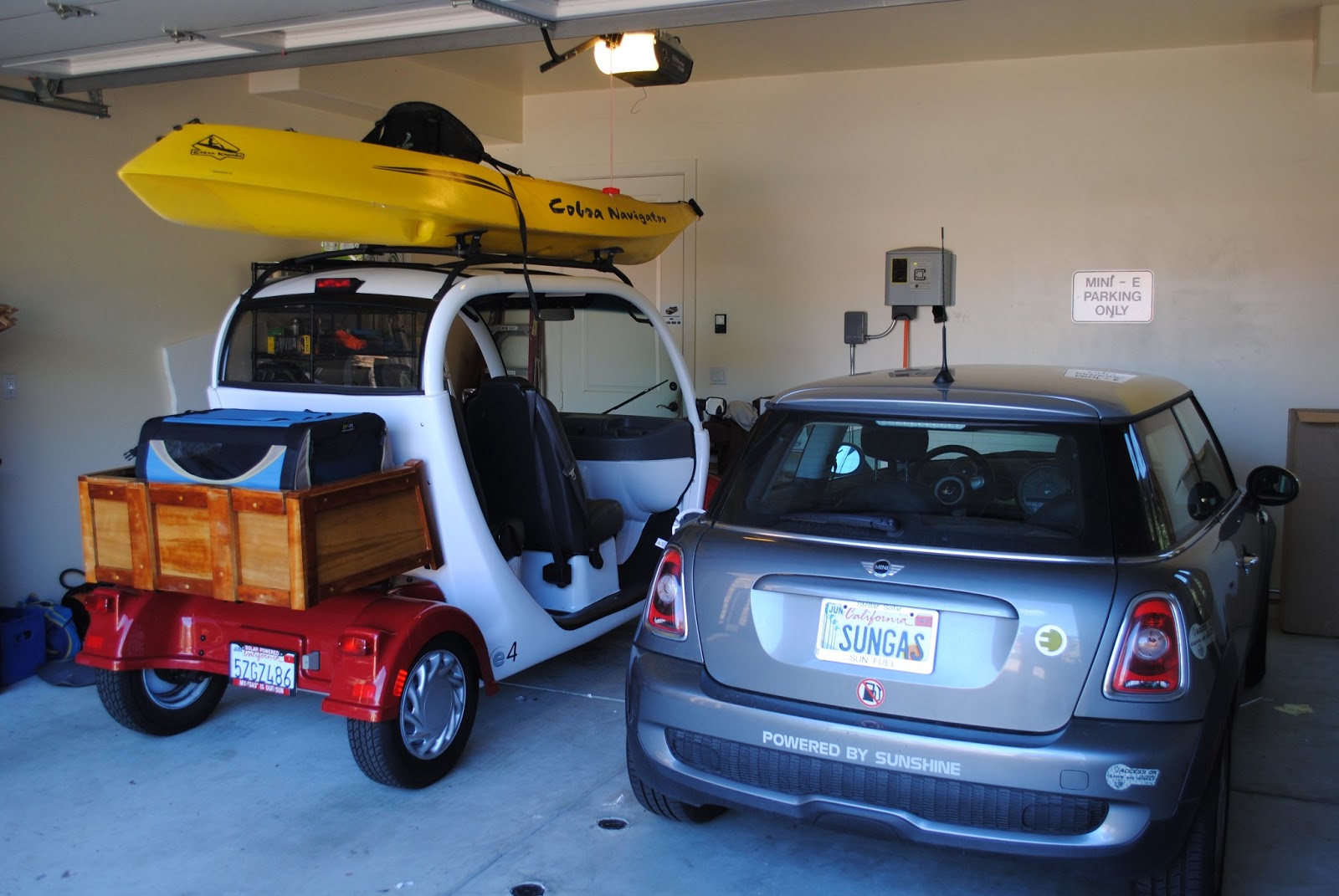
Woody shares the garage with Buzz for a year. Our version of Toy Story

Buzz is one handsome dude!

BMW cast Buzz, Buzz and I, in a four part documentary film on the future of mobility. 


Buzz in the vineyard in Temecula

Buzz parking only
Our first public charging. Pre-J1772 at South Coast Plaza

Buzz at the beach

Buzz camping in Borrego Springs


Buzz, with 38,000 miles meets Sungas

Julie claims/steals Sungas as her car

Julie and Sungas. Beautiful and Beautiful.

Sungas and solar, beautiful and beautiful

Sungas at 5400 ft above sea level, a 104 mile ride up and down the mountain


Sungas in Idyllwild Ca on a 550 mile vacation
Sungas enjoying a sunset

Sungas in the vineyards
Sungas  dropping into Palm Springs 

Sungas in the Anza Borrego Desert

Sungas at a dead dino juice station

The last gas car I ever owned, Good Bye Plastic Car.

EVangelizing at Plug in America Day

Two ev's sharing the plug love
Today is our one year anniversary with Sungas.
Julie and I will never buy gasoline again for the rest of our lives.


Thursday, January 17, 2013

GAStro 2020, "The Mother Of All Dinners" with my host, John Voelcker

I know John,,,When Pigs Fly....

I posted in the BMW ActiveE Facebook page that I thought the traditional gasoline car would become a niche vehicle, less than 50%, in the USA by 2020.
One of my electric car heroes (yes I think highly of his work)  John Voelcker, responded, err, took the bait, and challenged me to a “GAStro” dinner bet at the winners chosen eatery.

Here’s the good part of the bet….I get 50% of the winnings either way. As a goodwill gesture, I’m throwing in a 2007 Napa Silver Oak Cabernet that has his name on it.  It will be just peaking and a joy to drink in 2020 assuming John shares a glass with me.


Now I freely admit that the bean counters, auto execs, and Journo’s  pretty much think this is a safe bet for John. The same auto execs that are not afraid of Tesla but watch over their shoulder for every move that Tesla makes. Vegas would probably sends me off as a 20-1 underdog,  sort of like the Ravens against the Broncos in last weeks AFC divisional game.

However,  my clan is the clan of dreamers and doers, entrepreneurs and visionaries.   A 20-1 bet is a pretty sure bet to my clan.   I opened my first business when I was 20, 1000 folks told me no and two (my parents) told me yes. Odds were 500 to I,  and a made a few million.  I spent three years of my life going after the site selection of LEGOLAND for Carlsbad Ca.  The odds were 700-1. LEGOLAND is here and the city and county has made tens of millions.  I spent ten years restoring a commercial district when it was cast off as lost and relegated to serve as a petting zoo for old buildings. The odds were 100 to 1. Last year the district had $200 million in sales and property is now north of $10 mil an acre.

The point that I make here is that there are tens of thousands of folks in my clan who share the same dysfunctional wiring. Who simple don’t care what the odds are, they experience and create disruptive technology and can “see-dream” of the future.

But on to some facts and thoughts that bode well for those rooting for my side.

In Europe, my bet is already won with more than 50% of the cars sold being diesels in 2012.  Diesels will make good headway into  the US in the next decade.   They will establish a strong foothold by 2016 and then begin to take off. Look for Volkswagen to lead.

Light and heavy hybrids are projected to make up the majority of several automakers lineup by 2020.  The big reason here is regulatory mileage and strict emissions requirements.  In California the Hybrid uptake is currently at 8-9% I predict in 2020 it will be close to 50% in California and 10-20% across the nation.

While I’m not a big fan of fracking and cracking the earths crust, Natural Gas will emerge as a huge cheap player in the heavy and light vehicle segment. CNG cars and trucks will increase in sales due to the availability, low cost and relatively clean (80%+ cleaner than gasoline) natural gas supplies.

Computational power, energy storage and the reducing cost of Solar PV will combine to offer an alternative to gasoline that is already  less than 10% of the cost of Gasoline in 2013.  Only plug in cars will be able to access that fuel source.  It’s so cheap (I know as I am solar powered) that in 2013 Tesla is giving it away free.  The people of the US discovers this amazing fact around 2015 and the S as in Model S hits the fans.  Plug in Hybrids and electrics take off from there with exponential disruptive growth in 2017.  The energy to drive your car is sold when you buy your car for less than one year of buying gasoline, the energy sits on the roof of your garage or in a virtual net meeting solar PV field miles away.

China and India become gross consumers as the world emerges from its economic slumber. Gasoline goes to $6.00 a gallon.  The plug in electric car now runs at 5% of the cost of gasoline.  The cost of plug ins reach parity with gasoline cars.

Instability in the Mideast in the next seven years.  Thousands of years of history are on my side here.  Once again for the umptennth time our nation rallies to  get of oil.  This time there is a viable option and it works.

Battery densities accelerate from a current average of 8% increase a year to 12% increase a year.  By 2020 the 200 mile battery is common place at $200 per KW of storage.   Cycle life is in the 3000-5000 cycle range or 200K to 300K in miles (just as in my Honda Fit EV today.)

I could go on and on but the post is already too long. All of these don’t need to happen but a few of these will happen.  I’m pretty confident that by 2020 more that 50% of our sales will include hybrids, plug ins, electrics, CNG, diesal, dare I say fuel cell or flux capacitors.

Thanks for reading, thanks for being a good sport John. I look forward to our dinner together and to you picking up the tab.
The pragmatist and the dreamer….an epic battle is on.
What do you say?    What are the odds?


Cheers!
Peder
65,000 miles on sunshine power.